Powered by WebAds
Showing posts with label Foundations of Learning. Show all posts

Tuesday, August 01, 2006

The foundations of learning, Part III

continued from here.

Another foundational skill that needs to be acquired in learning is the ability to recall that which was learned – otherwise known as chazara. I often heard how important chazara is but what really hit it home for me was when I read a letter that Maran HaRav Kook Ztvk”l wrote to his brother in which he expressed horror about the fact that he heard that his brother only review each chapter of gemara three times before advancing to the next chapter. Rav Kook rebuked his brother and explained to him that in his experience, it is impossible to have any success in learning without reviewing each chapter at least ten times (!) before advancing to the next one.

Well, to put it mildly, I don’t exactly review each chapter I learn ten times. Frankly, I don’t even review it three times. I just don’t have the time to review so much with the 3 or so hours I can learn every evening. What I have employed a system of chazara that takes up little time and if very effective. Anonymous also emailed me his own personal system of chazara which I will also add to this post.

My system is not really my own. It really belongs to a certain talmid chacham who used to learn at the local beit midrash. He introduced me to a wonderful book called “מפתח סוגיות ועניני הש"ס” which was written by a talmid chacham in Eretz Yisrael by the name of Elhanan Kohn. (If your local sefarim store does not carry it, you can order it from the author at 03-6773393). This book is basically an topical index of the entire shas bavli. The most valuble part, however is not the index itself but rather the section in the back of the book title “מפתח לסדר הש"ס – לשינון ולזכרון הלימוד”. What this section does is list the sugyas of each massechet in the order they appear in the gemara in as manner as follows:
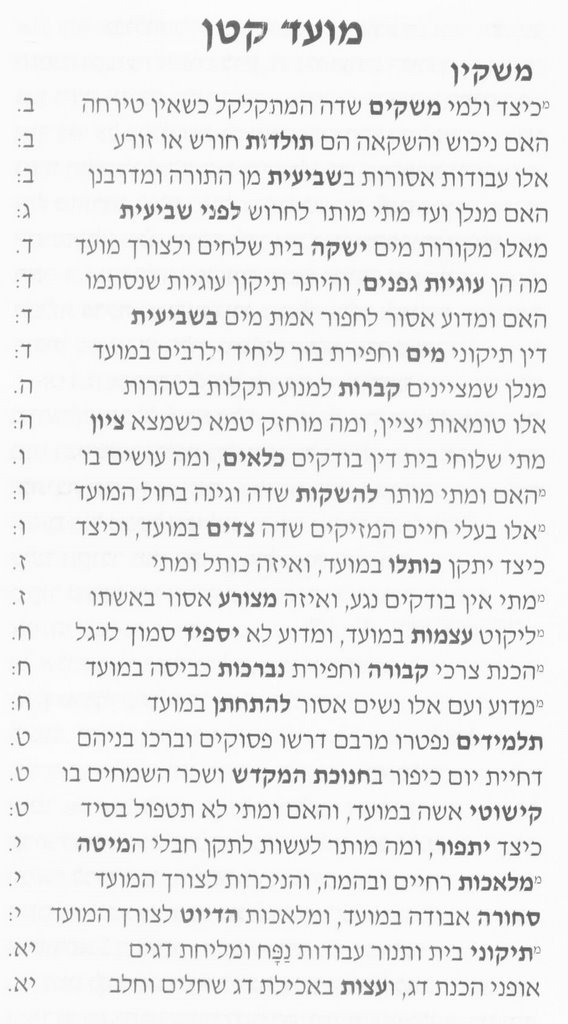


A dayly review of the sugyas you have learned in the past month or two is more valuable than you can imagine. It keeps the sugyas fresh in your mind and at the same time allows you to remember which page the sugya is located on. It is a quick way to attain a fairly high level of knowledge of the structure of the tractate you are studying. Of course, this type of chazara does not five you a great grasp of the shakla veTarya of the sugya but it is good within its own scope and is very valuable to baal-batim. I recommend to make a copy of the chapter you are studying and keep it in the gemara so that you can quickly review it before and after you start your seder.

Anonymous emailed me his own method of chazara:

The following is a suggestion for retaining a bit of the Torah that one learns. More accurately, it is the outline of a system that can be modified to one’s own taste. First and foremost, so many rabbanim stress the value of writing things down. They say that making summaries of mishnayos or gemara is an extremely important practice. However what type of summaries are they referring to? How long and how inclusive should they be? These types of questions must be answered, and IY”H, will be addressed in due course.
The first action that should be taken once having finished an amud, for example, is to break down the amud into its various meimras and sugyas. The breakdown ideally should not be the shakla v’tarya of the amud, but rather a four/five line (max.) summary of each sugya. So, if there are four sugyas or subjects on the amud, then what one should write down are four brief summaries. Preceding each summary should be an underlined phrase that sums up the entire summary. So if the topic, for instance, is yehareg v’al ya’vor (Sanhedrin 74a), then the summary title would be exactly that: yehareg v’al ya’vor, or any other phrase along those lines. The summary would then be something like the following:
Three mitzvos are yehareg v’al ya’vor: Shfichus Damim, Gilui Arayos, and Avodah Zarah. Machlokes by A”Z, but chachamim say from “b’chol nafshecha” that A”Z is one of the big three. The makor of S”D is a sevara of mi yeimar d’dama etc. which is then applied to G”A by the hekesh between S”D and A”Z.

Now, another beneficial step that can be taken is keeping a notebook where each side of a page represents a blat or an amud. This might be bit tough at first to fit all the necessary information in one page, but the advantage is that once the daf number is known (more on that in a moment), then the summaries can be quickly accessed.
A special effort should not be made to remember daf numbers, but rather where the major sugyos are located. This step will actually lead to one knowing the number of each daf, since the major inyanim will then act as mental notes, indicating one’s place in the perek.
Once one has the aforementioned two or three word (or more if necessary) summaries memorized or at least knows them very well, he can think about them wherever he goes. After a bit of repetition, the outline of a blat can be reviewed in under a minute. If one is in a place that affords him a bit of quiet, he can go over the full summaries, once he feels comfortable with them.
There is much more to say about the topic, but hopefully this introduction will encourage others to find a chazarah method in gemara that works for them. IY”H, a sample outline of a blat will be provided in the near future.

If you have your own methods, please let us know in the comments section. May everyone who reads this blog go from strength to strength and make a real kinyan on the Torah which they learn (beAhava!).

Monday, July 24, 2006

The foundations of learning, Part II

Continued from here

Another area that often needs to be built up in Jewish education is the study of Tanach - more specifically the Nach part of it. Of course, many people review the parsha every week so I would say the majority of people have a pretty solid grasp of the Torah (although there is definitely room for improvement). Almost nobody really knows tanach and the amount of people who went through a yeshiva education and have still never gone through all of neviim and ketuvim is somewhat shocking to be honest.

There are a few challenges in the learning of Nach. First, the language is often fairly difficult, the day school Hebrew education is pretty much sufficient for most of the early neviim. The average person can get through Yehoshua, Shofrim, Shmuel, and Melachim without too much difficulty. However, when one gets to the later neviim, Yirmiyahu, Trei Asar (not to speak of Mishlei and Iyov), they are pretty much lost. I know many people who have tried to learn tanach and stopped quickly after they started. Part of the problem is that people try to learn Nach in much the same way they approach chumash and gemara - they learn it from the commentaries. Don't get me wrong, the commentaries on Nach are great - it is just that before you can appreciate their greatness, it helps to have gone through Nach and acquire the underlying language and comprehension skills. That is why I recommend going through Nach several times without any commentaries, trying to understand the pshat of the words.

There are several benefits to this approach. First, Hebrew skills improve dramatically. Second, the psukim quoted in gemara learning become less cryptic and are more accessible. Third, a person actually learns the stories in Nach and the general themes and treasures hidden there.

There is, however, a problem. Efficient learning needs a structure and there is really no good structure/seder to the learning of Nach. One approach is learning a chapter a day. The problem with this is that: a) the chapters are of non-Jewish origin and often cause you to stop at an arbitrary point b) the chapter length is very variable - sometimes it is too long and sometimes too short. This does not lend itself to the establishment of a proper seder.

Luckily, Rabbi Seth Kadish has provided us with a wonderful service. He has created outlines for all the books of Nach and divided each book into (pretty much) equal sub-parts based on the massoretic chapters. The system is divided into 12 separate month cycles so that one can finish the entire tanach every year. Each day's portion is about 30-50 pesukim and usually takes about 20 minutes to get through. I highly recommend starting this system since it does not take up much of the day while at the same time building fundamental skills of learning which will improve other areas as well.

The sheets for the system are available in PDF format here

Thursday, July 20, 2006

The foundations of learning

One of my biggest complaints regarding Jewish education today is the lack of foundation that kids are given in our basic texts. It seems like much of the learning revolves around teaching gemara beIyun (in depth) while the basic units of knowledge (mikra and mishna) remain missing.

It is not that I am against Iyun, but I often feel like when people think that they are learning iyun, they are really just grasping a particular course of understanding but end up missing the relevancy of that understanding to the greater structure of Torah. For one to understand the depth of the rishonim, one must truly have a strong knowledge and understanding of the basic texts that the rishonim had mastered. And that means knowing mikra, mishna, and bekius (breadth of knowledge) in gemara.

The problem becomes even bigger for baal-batim such as myself. It is often hard to find time to sit and learn. When you do find time, it is often hard to reach a high level of concentration and the quality of the learning is often poor. One of the solutions I have found to this problem is the pocket size kehati mishnayot. I am sure you have seen these little green booklets. They are nothing less than phenomenal. To learn one mishna with kehati for the first time takes an average of 3-5 minutes. If you have already done that particular mishna before, it usually takes 1-2 minutes, sometimes even less. Now since there are an exact average of 8 mishnayot per chapter - to learn one chapter per day takes about 30-40 minutes if you have never learned it before and about 10-20 minutes if you have already gone through it.

Now, the benefits are amazing and almost immediate. If a person does one chapter of mishna a day, then they finish the shas mishnayot in a year and a half, two chapters a day is a nine month cycle and 3 a day is a six month cycle. After you have been through the shas mishnayot once, then it takes you about the same time to do two mishnayot a day as it took you to do one the first time. After you finish the second cycle, then you can usually do three a day in about the same 30 minutes that you allocated to it before. And the great thing about mishnayot is that, unlike gemara, you can really spread the learning out throughout the day. One mishna here, a couple there, three on your lunch break. The results are incredible. You will also see a distinct improvement in your gemara learning since much of the time you spent before on getting the basic concepts of the gemara down are already known to you from the mishna.

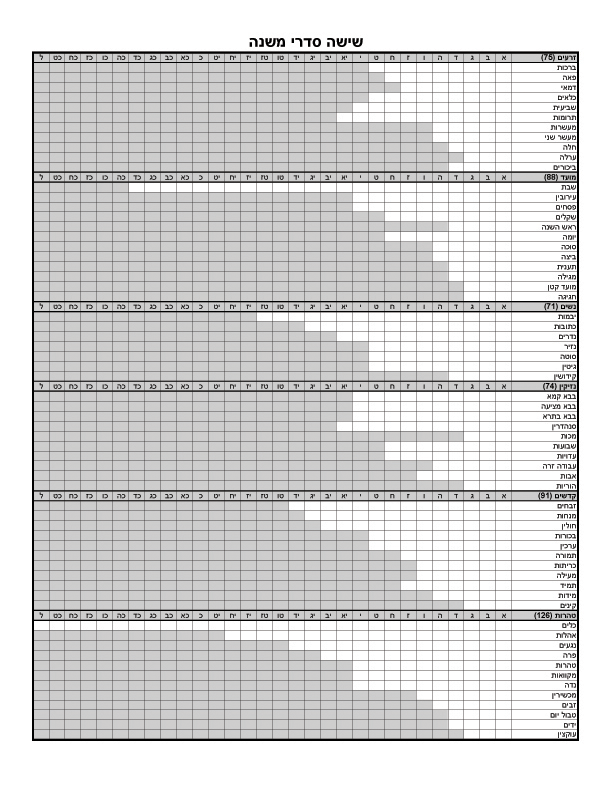
I have put together a little chart of the mishnayot that anyone can print out and save. I find that it helps to check off the mishnayot that I have done in each cycle and that keeping track generally give one a sense of accomplishment and motivation to keep up the seder. Please let me know if you end up trying this. It really helped me and I would like to know if others feel the benefits of this 'system'.

Here is the chart (email me if you want it in pdf format since it is better quality):