Powered by WebAds

Sunday, December 03, 2006

A Contemporary Commentary to Bava Metzia 84a, Part I

The post that Bari posted on the aggadata regarding Rav Yohanan and Reish Lakish generated some very heavy and heated discussion. I would like to attempt to offer a very different approach to this aggadata that I have been working on which I hope will give a possible understanding of the aggadata that will neither cast Rav Yohanan as a villain c”v, nor will it justify the problematic behavior described in the aggadata as I believe Bari’s post did.

My basic theory is that the Aggadata of Rav Yohanan and Reish Lakish is not an autonomous unit but rather the extension of the aggadata that precedes it. Here is the beginning of the discussion of Rav Yohanan on Bava Metzia 84a:

R. Yochanan said: ‘I am the only one left of the beautiful people of Jerusalem [people whose faces radiated with a special glow (Rashi)]. [Comments the gemara:] If a person wants to see this radiance of R. Yochanan, he should take a silver cup straight out of the silversmith’s furnace [while it is still glowing], fill it with the pits of a red pomegranate, surround the top with a crown of red roses, and place it between the sun and the shade; and this radiance is only a semblance of R. Yochanan’s beauty.

[The Gemara asks:] Is that so? For did not a Master say: The beauty of R. Kahane is only a small portion of R. Abbahu’s; the beauty of R. Abbahu is only a small portion of Yaakov Avinu’s; Yaakov Avinu’s beauty was only a small portion of Adam’s; and R. Yochanan is not mentioned at all in this cateogory! [The Gemara answers:] R. Yochanan was different, [he did have this luminous glow,] but he did not have a beard.

R. Yochanan used to go and sit at the gate of the mikveh. He would say, “When the daughters of Israel will come up from performing the mitzvah of immersing in a mikveh, let them see my face, that they should have sons that are as beautiful and as learned as I am.” Said the Rabbis to him, “Aren’t you afraid of an evil eye?” He replied, “I am an offspring of Yoseph against whom an evil eye is powerless.” For it says, “A charming son is Yoseph, a charming son by the well” (Genesis 49:22), on which R. Abbahu commented: Don’t read alei ayin, “by the well”, but rather, olei ayin, “above the [influence of the evil] eye.” R. Yose b. R. Chanina derived it from [Jacob’s blessing to Yoseph’s sons], “And may they proliferate abundantly like fish within the land” (Genesis 48:16): just as fish in the seas are covered by water, and the evil eye has no power over them, so, too, the children of Yoseph – the [evil] eye has no power over them.

There are several reasons to suggest that this aggadata was meant to be read together with the piece that follows it. First, this is a repetition of aggadatas that have already appeared in the Gemara (Berachot 20a and 55b). I think that it is fair to suggest that they were repeated here in order to give context to the story that follows. Further, using one particular understanding of Ayin Hara which I would like to put forth here, I believe that the two stories make up one conceptual unit.

What is Ayin Hara? There are many answers to this question. I would like to put forth a particular formulation of it which was advanced by Rav Kook in Ein Aya. In two remarkable pieces (Vol I, p. 102 and Vol II, pg. 275-6), Rav Kook develops the idea that the evil eye is a disturbance of those unseen social and spiritual connections that tie people to each other. None of us lives as an island, we are all affected by and affect a wider social reality that transcends our selves. Ideally, our relationship with others should be one of balance and propriety where each person takes into account his place in the greater fabric of life. Sometimes, however, a person may act in such a way that causes others to perceive him in a negative fashion. Behaviors that flaunt one’s advantages over others are the most likely to disturb the social balance. Such behaviors engender jealousy and hostility towards that person and then, on either a conscious or subconscious level, the person may respond with negative attitudes of their own until a cycle of hostility ensues which upsets man’s social and spiritual life on all levels. Thus, Ayin Hara is a natural process in which a lack of sensitivity to that which ties humanity together starts a chain reaction which disturbs those very ties and eventually hurts he who initiated such behavior.

How then, is Ayin Hara associated with Yoseph (or with fish, for that matter)? Yoseph is the prototype of someone so true to his self that he becomes impervious to the influences of the environment. Yoseph lived in a foreign culture with tremendous personal challenges and all the while, he stayed true to his inner purpose. Yoseph’s internal spiritual compass was so developed and autonomous to the point that the attitudes of others had no influence on the way in which he defined himself or his purpose. Such a person can allow himself more freedom in his behavior, not having to fear being affected by the ill-will of others. Such a person becomes so secure in his own sense of self that the negative attitudes of others are simply not factors in his day to day life.

Fish have a similar property. Fish live totally unaware of that which occurs over the surface of the water. They continue their life regardless of the actions of those above ground. This is the nature of Yoseph, he set up a mental barrier between himself and the rest of the world which simply did not allow him to be affected by the attitudes of others.

In talking of Yoseph’s immunity from Ayin Hara, we are then discussing protection from Ayin Hara in one direction only. That is, the protection of a person from attitudes others have toward them. It does not, however, guarantee, that Yoseph’s actions will not influence the attitudes of others towards themselves. Yoseph may not be subject to the ill effects of ayin hara; however, this does not mean that he can not disturb the inner lives of others.

In light of the preceding ideas, Rav Yohanan, a tremendously beautiful person, was not concerned with the indirect effect his social behavior might have had on his own spiritual growth. He was not concerned with publicly displaying his tremendous beauty and the potential jealousy that this may engender in others. Internally, he knew that his actions were for the sake of heaven and that he did not, therefore, have to fear the negative attitudes of others. He did not fear the small-minded jealously or the petty ill-will that others may or may not have toward him. This, I believe is central to our understanding of the next part of the story, that of Rav Yohanan and Reish Lakish.

Saturday, December 02, 2006

Rare Video of the Chazon Ish!

Thursday, November 30, 2006

Rare video of Rav Kook and Rav Sonnenfeld!

Sunday, November 26, 2006

Ramchal - 4th Hakafa

Continued from here.

If the last hakafa was one of the activity of man in his degraded state. This hakafa represents a return to passivity:


If the lessons that are to be learned from the exile are embedded into our hearts, we realize that all activity must reflect and show to the world how the Will of Hashem is all that truly acts in the world in the world. Our activity is only a channeling of that will and must never obscure people’s ability to see Divine providence on the world stage. However, this is a different passivity than that which is shown in the second hakafa. There we had the passivity that can only hope for a far-off ideal. Here we have a passivity that hopes for the concrete realization of that ideal and all the stages that lead up to that realization.

This is the first explicitly messianic chapter and it represents the desire of the destitute to see the historical transition from their lowly state to the elevated one. Visions of world justice and the universal recognition of Hashem abound. This chapter is right in the middle of the Hakkafot and thus rightly represents a pivot-point in the consciousness of the nation. The rest of the hakafot are of a different stage in world history. They represent the ultimate result of us understanding the messages of the first four. In the next hakafa, we already celebrate what will be in the future, when the events of this hakafa are complete. Thus, the Ramchal brings us to the present in four hakafot – possibly recognizing that the eternal nation who celebrates with their eternal Torah, can celebrate the inevitable result of world history before it even occurs. It is quite amazing when you think about it – a nation which celebrate in a concrete manner that which most of the rest of the world are not even convinced exists in the potential – in the end, however, that is what we are, the Am HaNetzach, and we must act accordingly.

Wednesday, November 22, 2006

Well, at least we have a security fence VI

Continued from here.

Well, after spending $1,000,000,000 on a security fence and destroying the lives of 10,000 precious Jews, channel 10 (reported in jpost here) wakes up to discover that the fence does not accomplish a thing:

Entire segments of the security fence near Jerusalem have been breached, allowing dozens of Palestinians to enter the country from the West Bank on a daily basis, Channel 10 reported on Monday evening.

According to the report, no fence remained at all for a stretch of some eight kilometers, and every meter or so, the upper part of the fence was bent.

Holes in the barrier were noted approximately every 100 meters, and the alarm system had been disconnected.

The discovery raises the question of the effectiveness of the barrier, which was built to keep terrorists from infiltrating the country.


Well, Neftuli, this is the 6th post on the topic. Are you ready to concede this point yet?

Monday, November 20, 2006

Lubavitchphiles unite

AddeRabbi has a great short post (funny and sad simultaneously) on the legacies of Lubavitch on the one hand and Satmar and Ponovitch on the other.

I always found it telling that there is so much anti-Habad sentiment on the web - it truly unites the yeshivish and the modern in many ways. I was never a part of it however. I, among countless others, probably owe my teshuva (at least partially) to Habad and their near boundless Ahavat Yisrael. On the other hand, my few encounters (before I was religious) with people claiming to represent the ideologies that most vehemently opposed Habad always left me with a strong desire to stay as far away from the religious world as possible.

Thus, it is not so surprising to me to see the way the detractors are handling their own succession issues.

Warning to commenters, any anti-Habad rhetoric which I subjectively feel passes the bounds of respect due to the movement will be deleted.

Rare Ramchal play now on the Net!

The Ramchal, among other things, was a playwright. For many years, his plays had been hard to get a hold of. Well, Now the Ben-Yehuda project has made available Migdal Oz - the most famous of the Ramchal's plays - online!

This play was written by the Ramchal for performance at Rav Yeshayahu Bassan's (the Ramchal's Rav in Kabbalah) wedding. It was written in 1727 when the Ramchal was only 20 years old. The early maskilim tried to "adopt" the Ramchal as the father of secular Jewish literature. However, careful reading of these plays shows an underlying mystical-religious theme which is really there in all of the Ramchal's work (this was brilliantly shown by Prof. Shimeon Ginzburg z"l in his work on the Ramchal). Anyone who is aware of the Ramchal's view of the world would immediately realize the absurdity of conceiving of the Ramchal as someone who lived life while conceiving of a divide between the secular and the Divine.

In any case,

Enjoy!

Wednesday, November 15, 2006

Ramchal - 3rd Hakafa

Continued from here.

The third Hakafa is a continuation of the second:


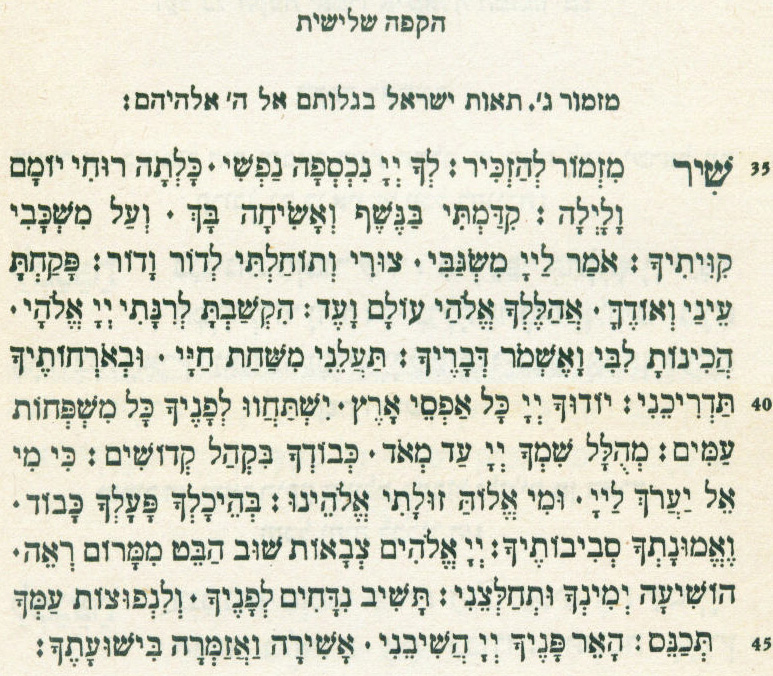
The necessary passivity of exile must give birth to some kind of mental or physical activity. To the Ramchal the first active element of exile must be the longing for the Divine. The relationship that was lost must be grieved over and the soul must actively express the longing for that which was lost.

The chapter is filled with imagery of man in his lowest state reaching out to the Divine. To the Ramchal the first lesson that exile must teach us is to appreciate the fundamental essence of the relationship between the Jewish people and Hashem. Playing on the lessons of the first and second hakkafot, the poet rises from passivity to declare his desire for the ideal. The desire is for the restoration of the relationship in both the intimate and private sphere as well as the public sphere. The poet declares ‘as I lay I hope for You’ as well as ‘all nations shall bow to You.’

This poem is one of activity after forced passivity and will be followed in the next hakafah by the expression of the desire to see Hashem remove the hindrances which keep us passive. The activity of the Jewish people in the mental/emotional sphere is followed by the desire to see the activity of Hashem in the world as we once again descend into passive mode.

Tuesday, November 14, 2006

Ramchal - 2nd Hakafa

Continued from here.

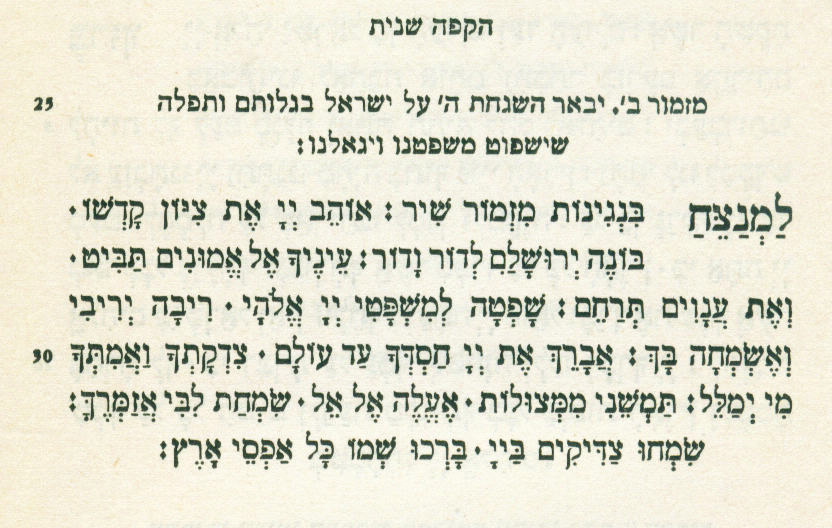
In the second hakafa we descend into our own reality. The full pain of galus is confronted in all its lowliness:


More humble. Less proud. The nation has to distill the core of the message while being stripped of all its institutions. The tone is more pleading than the first hakafat but even in exile the nation must be aware of its internal nature, but in a lower tone – “May Your eyes turn towards the faithful, and may You have mercy over the humble.” We recognize the ultimate justice of Hashem and ask that he have mercy on us. The tone is more passive just as the nature of exile is passive.

This is the direct opposite pole of the first hakafa. If in the first hakafa we want to instill awareness of our special active nature, in the second we must inculcate the idea the human activity by itself can never lead to redemption. We must realize that there is Divine providence which guides the world and that our actions must be in sync with that providence so that together, our action and Hashem’s providence will bring the world to its perfection.

We shall see in the third hakafa how this passivity must turn into active longing for Hashem. That, however is for another post.

Monday, November 13, 2006

Ramchal - 1st Hakafa

Continued from here.

The first Hakafa is joined by a chapter from the tehillim of the Ramchal:


The chapter starts by pointing out the impossibility of adequately expressing the greatness of Hashem. “Who will tell Your praise Hashem?” and the answer “We are Your servants, Hashem, You have made us. We will say Your Truth for all eternity! Together we will bless You!”

To be able to function as an individual one must be self-aware. One must know their abilities, their limitations, and their purpose. The same is true for the nation. A nation must know its special and unique nature in order to function properly. Thus the Ramchal has us declare that we are a nation whose ability and purpose is to declare the praise of Hashem in this world.

This hakafa is a set up for all the others. It is a mission statement that should make us aware that we have a task which no other nation can fulfill. We must make sure that Hashem’s name is praised through our national and communal life. This is something that the chapter seems to imply is only possible when we function as a national unit. This chapter represents our desire in its most ideal. We shall see that later hakafot are more aware of the limitations of reality but not this hakafa. One must start on a journey fully aware of what SHOULD BE. Only such awareness can give one the strength to engage reality in all its imperfections.

I will try to continue this series for the rest of the week. (I am just curious. Is anyone interested in this or does it just interest me?)

Sunday, November 12, 2006

Ramchal - before the hakafot begin

In light of my previous post on the Ramchal’s simchat Torah service, I thought I would start a series of post regarding the entire service the Ramchal innovated for the evening hakafot.

What we have left from the Ramchal is mostly his later writings. The vast majority of his most original and profound work was lost to us due the Herem of the Rabbis of Venice who succeeded in driving his esoteric and eschatological writings out of the public eye. One of the works which is lost to us is a “sefer tehilim” that the Ramchal composed in biblical Hebrew. We are lucky however that several chapters of this work made their way into liturgical writings which survived the ban. Out of the 150 chapters, only about 13 have survived and the Ramchal’s simchat Torah liturgy preserves 7 chapters in their entirety. I would like to attempt a series of post which will analyze the Ramchal’s approach to simchat Torah in light of the liturgy which he composed.

I would like to start with the following supplication, composed by the ramchal for recitation after the evening service is complete:


The recurring theme in this prayer is the choseness of the Jewish people and our collective experience as a Divine nation. The prayer also focuses on the special relationship between the Jewish people and Hashem, accentuating how the relationship is stronger than the one between Hashem and the other nations of the world. Special emphasis is given to the special providence which the Jewish people merit in this world – even in the state of exile. The prayer seems to also be very cognizant of our current state of exile and its theological implications.

What is missing from this prayer (and from that matter from the entire service) is any mention of the Torah. The entire service is completely involved with the nation and its relationship with the Divine. Even the type of personal relationship with the Divine whose achievement is the central focus of Messilat Yesharim is almost completely missing from this liturgy.

It seems that to the Ramchal, the national celebration of the Torah must reflect our national nature. Further – The joy of the day must not be achieved through the external aspect of the Torah as a separate entity but rather as the celebration of the Jewish people as a “Torah nation”, a nation whose very national soul is identical with the spirit of the Torah.

In my mind, I try to imagine how the Ramchal would see the act of circling the bima holding sifrei Torah. I do not think that he would view the ritual as an act of the Jewish people showing respect to an external revelation but rather as a conflation of the sefer Torah with the Jewish people who together experience joy as they start to realize that they both represent the imprint of the infinite upon this coarse and finite world.

Hopefully, as we go through the 7 hakafot, we will find even greater clarity and insight into how the Ramchal saw the holiday as one of both national and eschatological significance.

Tuesday, November 07, 2006

To the process of ideas in Israel

MevaseretZion has a great summary of Rav Kook's masterpiece, "To the process of ideas in Israel."

Check it out!

Monday, November 06, 2006

Ramchal on Simchat Torah

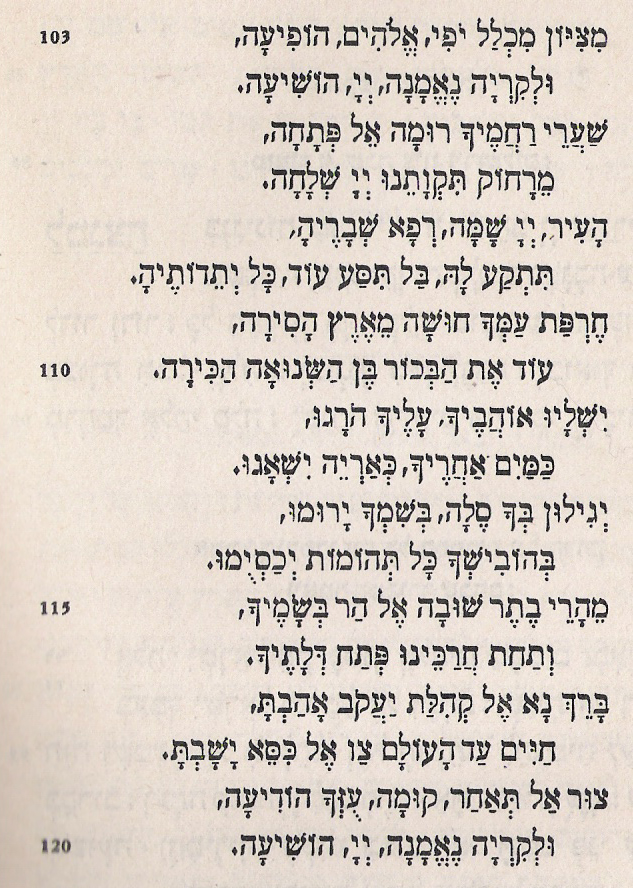
This is a poem the Ramchal wrote to be included in the Simchat Torah liturgy after the 7th hakafah. Read it carefully. The ramchal saw the hakafot as being expressive of the desire of the Jewish people to return to the land of Israel and see it rebuilt.

The hakafot may have been seen by the Ramchal as a re-enactment of the hakafot that the Jewish people observed before the conquest of Yericho. The ritual may demonstrate that the the ultimate purpose of Torah is not just abstract thought but also to bring that abstract thought down into the world.

In other words, the purpose of simchat Torah to the ramchal was not simply to have abstract joy engendered by the Torah but rather to channel that joy towards real spiritual and physical goals.

How do you understand this poem in light of the traditional theme of simchat Torah?

Wednesday, October 18, 2006

Excerpts from the secular bible

Jameel posts here about the response of MK Oron to criticism of his perverted legislation proposing to outlaw Jewish outreach to minors.

I will not be posting about the actual content of the letter. Rather I want to focus on the concluding sentence of the letter:

אני מבין שאתה לא מסכים עם דעתי זו ולכן איש איש באמונתו יחיה

I understand that you disagree with my viewpoint, and therefore, "[every] person in his own faith shall live"
The last portion of the sentence איש איש באמונתו יחיה is often used by secular Israelis to connote the ideal of freedom of conscience for all. They often quote it in a ‘biblical’ manner and I am pretty sure that many are convinced that this is actually a biblical verse. In truth, it is a prime example of the appropriation of a biblical concept by secular Zionism and turning it into a slogan either ambivalent or hostile towards religion.

In our holy literature, the phrase which closest approximates the above form is found in the book of Habakkuk 2:4
הִנֵּה עֻפְּלָה, לֹא-יָשְׁרָה נַפְשׁוֹ בּוֹ; וְצַדִּיק, בֶּאֱמוּנָתוֹ יִחְיֶה.

Behold, his soul is puffed up, it is not upright in him; but the righteous shall live by his faith.
Traditionally, this concept has been used in our writings to teach the importance of being faithful to our God and His Torah. Of being true to our traditions and living a life of faith and goodness. It is a shame that instead of learning about our beautiful heritage, there are MKs who would rather legislate laws in order to keep large segments of society ignorant of it – and using corruptions of biblical verses no less!

Thursday, September 28, 2006

Yom Kippur Thoughts

Pre Yom-Kippur thoughts. The Maggid of Mezritch writes (צוואת הריב"ש, עמ' י-יא):

ואני בוטח בו שהוא ברא כל העולמות בדבריו יש מאין והכל מאין נגדו והוא משגיח עליהם לתת להם שפע וחיותם וכ"ש שיכול להוריד לי כח וישגיח בחסדיו גם עלי ויצילני שלא יבטל אותי יצה"ר בשום דבר בענויי שיאמר לי שאני חלש ונתייבשו המוחין שלי וכן כמה פיתויים


I trust in Him – that He Who created all the worlds through His word Ex Nihilo and compared to Whom all of existence is nullified and He watches over them [the worlds] to give them their sustenance – All the more so that He can grant me strength and in His mercy watch over me and that He shall rescue me so that my evil inclination will not afflict me by saying that I am weak and that my intellect has dulled and other similar enticements.

This basic idea in chassidus is quite revolutionary in its implications. It straddles quietism and activism simultaneously seeing man as that creature in the world which can passively receive and behold divine Will while at the same time seeing man’s personal strength and activity as the correct manner in which to channel that Will. Many people see teshuva as a process which weakens man’s will and forces him to come to terms with his own failings and his true insignificance in the world. The approach of the Mezritcher is the exact opposite –any view which causes man to acknowledge his own weakness is a result of the evil inclination. Each of us must become strengthened and aware of our abilities to channel the light of Hashem into this dark world. This task will not be achieved through acknowledgement of weakness but rather by a strengthening of the divine component of our will.

May we all merit to gain more strength this Yom Kippur. May Hashem forgive all the sins of the Jewish people and may this year be the year of our final redemption.

Thursday, September 21, 2006

Shana Tova

I recieved the following Dvar Torah from one of the readers. I thought it was very beautiful and wanted to share it with everyone:

Rav Yitzchak Izik Sher (Leket Sichot Mussar, Vol 2, p. 34) quotes a famous statement of Maimonides (Rambam) that every single person has merits (mitzvot) and negative acts (aveirot). One whose merits are greater is “good”, one whose negative acts are greater is “evil”, and one whose merits and negative acts are equal is “in the middle” – which is how we should view ourselves, especially at this time of year. The Rambam complicates this statement by adding that there are certain positive acts which, alone, equate to many negative acts and vice versa – however, the only one who can make such a calculation is G-d. Rav Sher, quoting a number of sources, raises the question – how do we know if we are doing enough to make sure that we are being judged favorably? What should our approach be to raise ourselves to the level of a “good” person, worthy of a positive judgment on Rosh HaShana?

Rav Sher suggests a marvelously simple yet profound approach that can be applied to all mitzvot as well as to avoid negative acts. When performing a mitzvah, it is not simply enough to comply with the legal requirements, rather, one must also do it with one’s heart as well. By looking at a positive act not simply as an obligation, but as a way of life, worthy of sacrifice and effort, one is transformed as the mitzvah is no longer an abstract act, but rather a way of life that serves to improve not only the participant, but all of those impacted by it as well. We do not know how G-d views that specific mitzvah – whether or not it counts for a lot or a little, but we can certainly use the heartfelt emotion and feeling as a means to truly enhance and improve our overall lives.

Tuesday, September 19, 2006

The demographic problem

Read about what you can do to help on MevaseretZion.

Thursday, September 14, 2006

Various musings

Arutz Sheva reports that a recent study showed 44% of chareidi men are actively engaged in the work force. I have to assume that this number will increase as the community grows and as economic reality becomes more pressing.

The reason I am posting this is so that next time someone starts ranting about how the chareidim live off the backs of others, this should be brought up. nearly half support themselves to the best of their abilities and the other half (many of whom dedicate their time to learning) can hardly be considered to be living in the lap of luxury on the backs of others.

I have seen many blogs bring up sectarian issues lately. I think this is wrong and harmful - especially in this month of Elul when we should be concentrating on that which binds us and not that which separates us. All who choose to accept upon themselves the framework of Torah are bound together in an eternal covenant. There are very serious disagreements and debates that will probably continue for a long time - sometimes these disagreements lead to speech and terms that cross the lines of propriety. However, at the end of the day we must re-assert the covenant that ties us together. We must reassert that we share a common destiny and that we are all part of an organic whole.

There is an anecdote about the Ariz"l. The Ariz"l once stated that the purpose of galut is to collect the 'sparks' that are latent among the nations of the world. A student challenged him and said, "If the Jewish people had not sinned and gone into exile, then what would become of those 'sparks'?" The Ariz"l answered that when the Jewish people act as an organic whole and use all their strength in a combined fashion, then the sparks are attracted to that organic whole and 'rise' by themselves. In other words, our task of redeeming the world must be accomplished - it is built into the fabric of reality - it is up to us if we want to accomplish it through the beauty of what we could be or, God forbid, through a less than ideal set of circumstances. In the end, reality will force our hand - it will just be better if we change the reality so that it won't have to force anything.

Tuesday, September 12, 2006

ADL - Anti (self-)Defense League

ADL Slams MK Effie Eitam's Statements on Transfer of Arabs
12:33 Sep 12, '06 / 19 Elul 5766

(IsraelNN.com) The US-based Anti-Defamation League (ADL) has issued a condemnation of Knesset Member Effie Eitam (National Union-NRP) following Eitam’s call for the transfer of Arabs from Judea and Samaria and removal of Israeli-Arab Knesset members.

“Such inflammatory statements are irresponsible and display an ugly and abhorrent bigotry against other peoples and leads to incitement,” the ADL statement said. “Calls by public figures to ban minorities and expel them from their homes are abhorrent. These are irresponsible statements advocating collective measures that the ADL totally rejects.”

“Eitam’s remarks do nothing to further Israel’s quest to live peacefully among its neighbors and are an insult to its loyal Arab Israeli citizens,” the statement, issued by the group’s Israel office, concluded. “ADL rejects the notion of transfer of any people from their homes and homeland.”

The ADL was a vocal supporter of Ariel Sharon’s Disengagement Plan, which called for the forced expulsion of nearly 10,000 Jews from their homes in Gaza and northern Samaria.


I would be disappointed if I actually expected something from this band of hypocrites. Of course they are wrong - there is nothing morally wrong with the population transfer of a hostile population. There IS something wrong with leaving such a population in place and endangering the well-being of your own population. In truth, they understand this since they supported the expulsion of Jews when they felt it would better Israel's situation. Now, why all of a sudden does population transfer become a global moral standard? Hypocrites! When will they stop bowing at the alter of western civilization? Democracy is a practical tool, not an independent global value.

I am all for democracy (since it works well most of the time) but when the values of democracy endanger the well-being of 5 million Jews, they have to be compromised - period.

Monday, September 11, 2006

The flip side of the coin

The following is a coin that was minted during the begining of the bar Kochba revolt in 133 ce:


For those who do not know, the full name of Bar Kochba was Shimeon ben Kosiba. He led a revolt against the Romans which lasted for 3 years during which he controlled a significant part of Yehuda (although he never controlled Yerushalaim). The revolt was an initial success but it came to a grinding halt with Bar Kochba's death in Beitar.

Much attention has been paid to the messianic component of the revolt. Rabbi Akiva was the spiritual leader of the rebellion and, along with the majority of the sages of his generation, considered Bar Kochba to be the Mashiach.

What I find interesting about the coins from this era is that the consistently refer to Bar Kochba as "Nasi" instead of what I would have expected which would have been "Melech." The title of Nasi, as far as I knew until I saw these coins was generally reserved for the head of the high court during the time of chazal. I find it surprising that Bar Kochba would refer to himself as "Nasi." Does anyone have any explanation for this?